Prerequisite: Part 9 of the Harness Engineering deep dive. Builds on the session-memory loop (Ch08) and bridges into Ch11 — Build Your Own Harness.
Same models, different receipts. The lever is what your org has learned that no one else can copy.
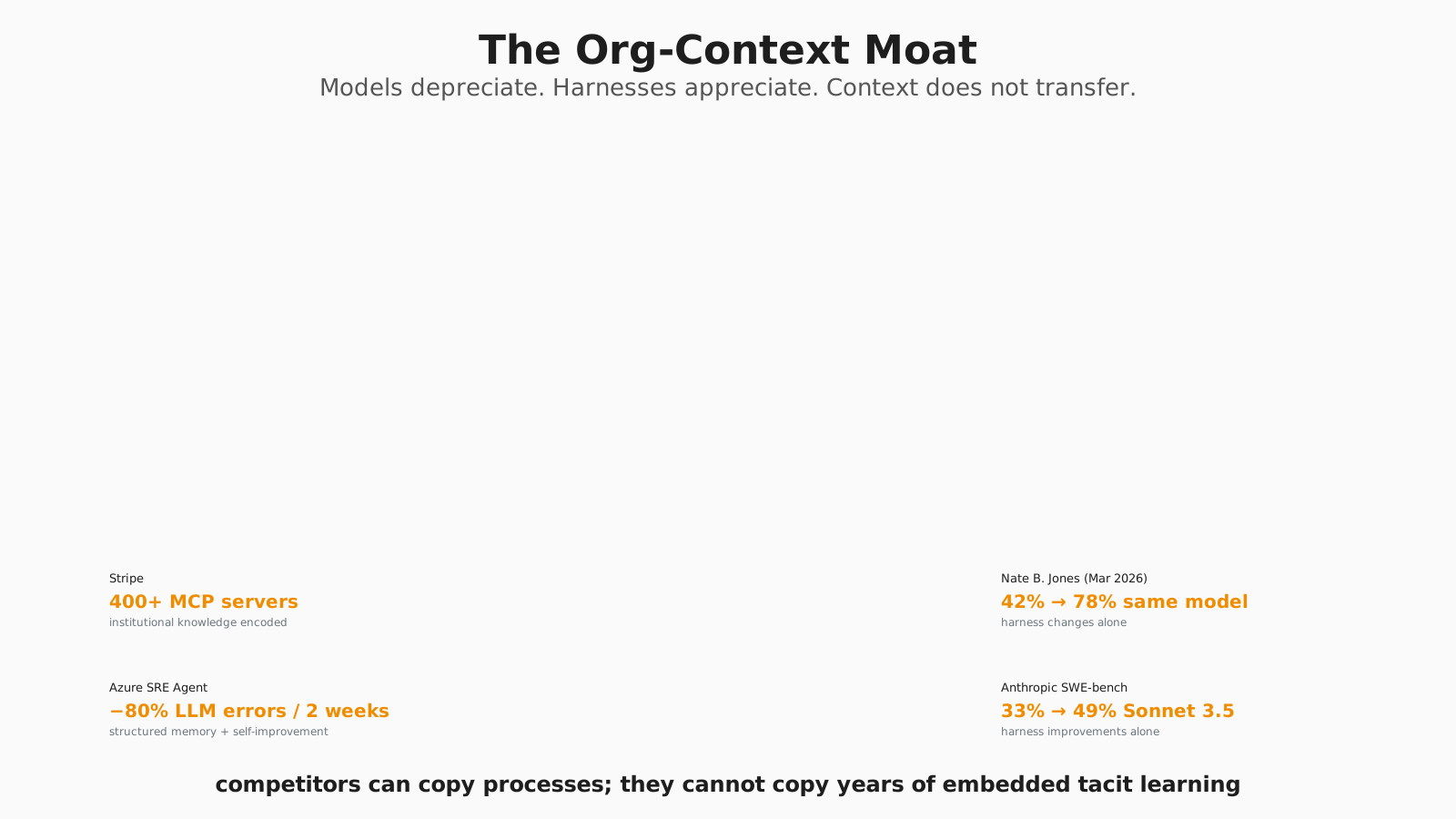
Models depreciate. Harnesses appreciate. Context does not transfer.
Why This Matters
Most public writing about AI moats names the wrong layer. The standard list is data, scale, distribution — sometimes a finetuned model on top of a proprietary corpus. That framing treats the moat as a thing the org owns: a dataset, a brand, an exclusive contract. It is wrong in a specific, operationally costly way. The durable competitive layer is not a thing, it is a learned execution pattern — the workflows the team follows across systems, the signals they respond to, the order in which roles get involved, the exceptions that trigger action [hbr2026]. That layer transfers freely within an org because they share the substrate. It does not transfer between orgs, because the substrate is the org itself.
The receipt is in the spread. The same model can swing from 42% to 78% success rate based solely on surrounding harness [nbj2026]. Claude 3.5 Sonnet moved from 33% to 49% on SWE-bench Verified through harness improvements alone, no model change [anthropic-swe]. Both say the same thing: the model is a fixed coefficient, the harness is the multiplier. If your org’s harness sits at 42% and a competitor’s at 78%, you are not behind on AI; you are behind on the substrate that makes AI work, and no model upgrade closes the gap.
The economics push the lever harder every cycle. Models are commoditizing — DeepSeek shipped frontier-quality output at a fraction of incumbent cost, cached tokens trade at 10× cheaper than uncached [boh-p3, manus2025], and frontier swaps land more often than annually now. Harnesses run the other direction. Every encoded fix prevents the next instance of a class of failures; Mitchell Hashimoto (HashiCorp) named the discipline directly — “anytime you find an agent makes a mistake, you take the time to engineer a solution such that the agent never makes that mistake again” [boh-p3] — and the result is monotonic accumulation. Models depreciate. Harnesses appreciate. The two lines are crossing, and this chapter is about the layer between them.
Takeaway: The moat is not data, scale, or distribution; it is org-encoded harness context — workflows, signals, exceptions — that compounds inside the org and does not cross the boundary. The 42→78 and 33→49 spreads are the receipts; the rest of the chapter is the architecture that produces them.
The Compounding Mechanism
Hashimoto’s discipline has a specific architectural shape: agent fails; root cause is diagnosed; the fix is encoded into the harness — AGENTS.md, CLAUDE.md, a linter rule, a custom tool, a guardrail; every future session inherits the fix; a class of problems is prevented, not just the instance [boh-p3]. Same shape as the session-memory loop in Ch08, promoted from one developer’s substrate to the org’s. The reflector is the post-mortem; the curator is the team member who decides the fix is worth encoding and edits for generality; the substrate is whatever artifact the next session reads. Each fix retires a category, and the category does not come back even when the input distribution shifts.
Two anchor numbers are the proof. Nate B. Jones’s March 2026 receipt — same model, 42% → 78% success rate, harness as the only variable [nbj2026] — is the operator-side data point. Anthropic’s SWE-bench Verified result on Claude 3.5 Sonnet — 33% → 49% through harness improvements alone [anthropic-swe] — is the controlled version. Both hold the model fixed, move the harness, and report a swing large enough that model identity stops being the load-bearing variable. The model is the floor; the harness is the ceiling; the spread is what compounding has built up.
The mechanism explains why generic public harnesses underperform org-specific ones. A public scaffold encodes generic disciplines — schema validation, retry budgets, replay safety (Ch05), cache stability (Ch07). It cannot encode the specific class of mistakes your codebase invites — the constraint chain that makes one schema work and another fail under your load, the ordering quirk in your downstream service, the workaround for a deprecated upstream API. Those classes are visible only after the agent has tripped on them in your environment.
        session N                              session N+1, N+2, ...
      ─────────                              ──────────────────
          │                                          ▲
          ▼                                          │
     ┌────────────┐                           ┌─────────────┐
     │  AGENT     │ ── fails on a ──────────▶ │  durable    │
     │  attempt   │   specific instance       │  substrate  │
     └─────┬──────┘                           │  (AGENTS.md │
           │                                  │   CLAUDE.md │
           ▼                                  │   linters,  │
     ┌────────────┐                           │   tools)    │
     │ DIAGNOSE   │ ── identifies ──────────▶ └─────▲───────┘
     │ root cause │   the CLASS, not                │
     │            │   the instance                  │
     └─────┬──────┘                                 │
           │                                        │
           ▼                                        │
     ┌────────────┐                                 │
     │ ENCODE     │ ── promotes fix ────────────────┘
     │ (curator)  │   into substrate
     └────────────┘   the next session reads

Receipts:
  Nate B. Jones (Mar 2026): same model, 42% → 78%
  Anthropic SWE-bench Verified: Claude 3.5 Sonnet 33% → 49%
                                (harness improvements, no model change)

Failure mode: fix the instance, not the class. Same failure recurs
next month with a different file name. Takeaway: The loop is agent-fails → diagnose-class → encode-fix → next-session-inherits. Hashimoto’s rule names the discipline; the 42→78 and 33→49 spreads are the receipts. The class — not the instance — is the unit of compounding.
Why Context Doesn’t Transfer (Three Reasons)
HBR’s February 2026 framing is the cleanest statement: “When Every Company Can Use the Same AI Models, Context Becomes a Competitive Advantage” [hbr2026]. The piece names org context as “demonstrated execution: the workflows teams actually follow across systems, the signals they respond to, the order in which roles get involved, the exceptions that trigger action” [hbr2026]. That definition is load-bearing — execution, not strategy; demonstrated, not documented; across systems, not within one tool. Three properties explain why the context cannot transfer between orgs even in principle.
Tacit knowledge. The patterns “live in emails, chats, spreadsheets, working documents, and conversations” and “largely disappear once the deal moves forward” [hbr2026]. The OpenAI Codex team echoes it: “Knowledge that lives in Google Docs, chat threads, or people’s heads is not accessible to the system” [boh-p3]. The substrate the agent reads is not where the knowledge lives. It lives in side channels — the Slack thread that established the workaround, the PR comment explaining why a library version was pinned. Artifacts capture outputs; side channels capture process, and the process is what the next session needs to avoid re-deriving the same dead end.
Organization-specific encoding. Context reflects how a specific org has learned what succeeds in its market, given its constraints [boh-p3]. Stripe’s harness encodes 400+ internal tools surfaced through MCP servers [boh-p3] — each shaped by how Stripe runs payments, which fraud signals their data taught them to weight, which country regulations they have absorbed. A competitor cannot adopt Stripe’s MCP catalog because the catalog is the encoded form of years of Stripe-specific execution. Azure SRE makes the same point at the substrate layer: structured Markdown memory because embedding similarity ≠ diagnostic relevance for that specific system [boh-p3].
Execution visibility gap. Systems record outcomes — closed tickets, merged PRs, shipped releases — but not how execution unfolded. The order roles got involved, the alternatives dropped, the moment the constraint forced a redesign — none of that is in any system. It lives in the heads of the people who ran the execution, and it evaporates when those people move on. The same 80/20 dynamic the session-memory chapter named at the developer level (Ch08) shows up organizationally: the 80% of execution that lives in artifacts transfers, the 20% that lives in reasoning does not, and the 20% is what makes the org’s harness valuable.
Takeaway: HBR names execution — workflows, signals, role order, triggering exceptions — as the moat. Three properties (tacit knowledge in side channels, org-specific encoding, the execution visibility gap) explain why the encoded harness travels within an org and stops at the boundary. Stripe’s 400+ MCP and Azure SRE’s structured Markdown are the worked examples.
Network Effects Within and Across Agents
The harness compounds in two directions. The internal effect is the loop above, scaled by usage: more usage surfaces more failure modes, more failures drive more encoded fixes, more fixes drive better performance, better performance drives more usage [boh-p3]. Jerry Chen (Greylock): “The more data you generate and train on with your product, the better your models become” [boh-p3]. NFX: “Each additional user improves the product for existing users” [boh-p3]. Every additional agent invocation in your org is a draw against a larger pool of learned failure modes, and the pool is yours alone.
Cursor’s adoption data is the org-level instantiation: “When entire engineering teams adopt Cursor… Switching costs multiply with team adoption” [boh-p3]. The switching cost is not the tool — the tool is generic. The switching cost is the team’s accumulated harness: the rules each engineer added, the snippets standardized on, the patterns the codebase now expects. A new tool starts at the 42% end of Jones’s spread; the established team operates at 78%. The asymmetry is the moat.
The cross-agent effect is the next-layer multiplier. Azure’s SRE Agent runs tens of thousands of incident investigations each week, enriching shared memory across the deployment fleet [boh-p3]. Each investigation feeds the substrate the next one reads from. No competitor — even one running the same model and a generic SRE scaffold — has access to that investigation history, because the history is generated inside Azure’s operational boundary by Azure’s systems running Azure’s customers’ workloads. The org’s operational footprint becomes the agent’s training environment.
The compounding curve has a name from the moats literature — Amazon’s flywheel and Wright’s-Law experience curves [boh-p3]. Every doubling of sessions surfaces new failure modes; each encoded fix reduces the class of future failures. An agent that does not write back into the substrate is the AI-equivalent of a contractor; an agent that runs the loop is the AI-equivalent of a tenured engineer. The choice is whether the substrate is set up to receive the deposits — which is what the rest of this series builds.
Takeaway: Two compounding directions — internal (more usage → more fixes → more usage) and cross-agent (Azure SRE’s tens of thousands of investigations per week enriching shared memory). Cursor’s switching-cost asymmetry is the team-level proof. The agent-as-tenure-versus-contractor frame is what the architecture enables.
The Economics: Commoditize-Your-Complement
The economics framework underneath the moat is the Spolsky/Gwern “Commoditize Your Complement” pattern [boh-p3]. When the price of one input in a value chain falls toward zero, the adjacent layer captures the value released — and the rational move for an org selling the adjacent layer is to push the commoditizing layer’s price down faster. Models are the commoditizing input. Harnesses are the adjacent layer. The Dev|Journal phrasing names it: “The model is a commodity. The harness is your moat” [boh-p3].
The commoditization receipts are visible. DeepSeek ships frontier-quality output at a fraction of incumbent cost [boh-p3]. Claude’s cached input tokens trade at 10× cheaper than uncached — the Manus data point — meaning a stable cache (Ch07) is the difference between paying full input price and a tenth of it [boh-p3, manus2025]. Frontier swaps land more often than annually now. None of those movements affect the harness’s value; they affect the price of its complement.
Harrison Chase lands the operational implication: “When agents mess up, they fail because they lack the right context” [boh-p3]. The model is rarely the bottleneck on a failing agent; the context is. A team that raises model quality — paying more per token, switching to a slightly newer model — buys a percentage point or two. A team that invests in encoding the context the failing agent lacked moves from the 42% end of Jones’s spread toward 78%. The ROI of the latter dominates by an order of magnitude, and the gap widens as models commoditize further.
The strategic move is uncomfortable for orgs anchored on the model: push commoditization on the model layer where you can — multi-model harnesses, swap on cost-quality curves, refuse to rewrite the harness to fit one model’s quirks — and pour the freed budget into the org-specific harness layer. The pattern is symmetric to AWS pricing storage and compute close to cost to keep adjacent orchestration priced high. For an org running agents, the model is storage-and-compute; the harness is the orchestration.
Takeaway: Models are commoditizing — DeepSeek, 10× cached vs uncached, quarterly swap cycles. Commoditize-your-complement names the dynamic; the harness is the complement whose value rises as the model’s falls. Push model commoditization; invest the freed budget into the org-specific harness layer.
ROI Receipts
Four receipts span the spectrum from population statistics to single-team mechanism.
Quantitative ROI is mainstream: 74% of executives see ROI within the first year, 62% of companies anticipate 100%+ ROI, and the average ROI for firms moving from pilots to production is 1.7× [boh-p3]. The moat thesis predicts most production deployments see ROI in the first year once the substrate is in place; the population statistics agree.
The most-cited operational receipt is Azure’s SRE Agent: LLM errors dropped 80% in two weeks [boh-p3]. The mechanism: “Whenever it gets stuck, we talk to it and teach it, ask it to update its memory, and it doesn’t fail that class of problem again” [boh-p3]. The 80% is not a model upgrade; it is two weeks of the loop running. The receipt is the velocity of compounding.
OpenAI Codex’s number is the same shape at build velocity: 1M lines of code in weeks with the agent-first methodology [boh-p3]. The substrate set up to receive deposits as the agent works is the multiplier; the marginal improvement is not “use an agent” but “run the loop.”
Manus names the cadence: framework rebuilt 4 times in 6 months, shipping “improvements in hours instead of weeks” [boh-p3]. Cycle time dropped because the loop became the architecture rather than the side project. The Compounding Engineering pattern lands the practitioner version: “I can hop into codebases and start being productive even though I don’t know anything about how the code works because we have this built up memory system” [boh-p3]. Productive-without-knowing-the-codebase is the moat from the operator’s seat. The substrate does the work the developer would otherwise do — and it is the org’s substrate, not the developer’s.
Takeaway: 74% / 62% / 1.7× as population statistics; Azure SRE −80% in two weeks as the mechanism receipt; Codex 1M lines as the velocity receipt; Manus 4 rebuilds in 6 months as the cadence receipt. The bench is the loop running, not the model upgrading.
The Cold Start Problem
The fair objection: this is great for orgs that already have a substrate; what does the team starting from zero do? The primary source surveys six bootstrapping strategies, all with the same shape — set up the receiving substrate first, let real failures drive what gets encoded [boh-p3].
AGENTS.md as table of contents — the OpenAI pattern: ~100 lines pointing to deeper sources, not 1000 lines of inlined detail [boh-p3]. The 100-line cap matters because AGENTS.md is hot-memory (Ch08) — it lives in the always-loaded prefix and pays the cache-stability tax on every turn (Ch07). It should be the index-in-context pointing to bodies on disk, not the bodies themselves.
Context hooks — the Azure SRE pattern: inject structured context at prompt-construction time, not at memory-store time [boh-p3]. Hooks are authored once, reused across every agent invocation; the team’s first investment generates leverage before failure modes have been observed.
Auto-generated starting points — /init plus auto-memory accumulation — turn the first session into a substrate-creation event [boh-p3]. Run /init once, get a scaffolded AGENTS.md or CLAUDE.md, edit down to truth. Auto-memory (Ch08) then accumulates session observations into the substrate without explicit author effort.
Transfer from existing human knowledge is the move teams under-appreciate. Pre-commit hooks, linters, structural tests are already a harness [boh-p3]. The team has been encoding execution discipline for years; the cold start is “expose what we already have to the agent,” not “write everything from scratch.”
Progressive enrichment — start minimal, let real failures drive encoding [boh-p3]. The temptation is to pre-encode imagined failure modes; the discipline is the opposite. Encode after a real instance hits, and encode the class not the instance. The substrate grows in the shape of the real failure distribution.
Filesystem as world model — the Microsoft pattern: expose everything the agent might need as files [boh-p3]. Same architecture as Ch06 and Ch08 — index in context, body on disk, harness as the gate — applied to the entire org-context surface. Retrieval becomes “list, read, verify” rather than “guess from a vector blob.”
  cold-start moves (do all six; order them roughly top to bottom)
────────────────────────────────────────────────────────────────

 1. AGENTS.md as table of contents (~100 lines, OpenAI pattern)
    └─ pointers to deeper sources, NOT inlined detail

 2. Context hooks (Azure SRE pattern)
    └─ inject structured context at prompt construction

 3. /init + auto-memory accumulation
    └─ first session writes substrate, not just code

 4. Expose what you already have
    └─ pre-commit hooks, linters, structural tests
       are already a harness — make them agent-addressable

 5. Progressive enrichment (the discipline)
    └─ start minimal; let REAL failures drive encoding
    └─ encode the CLASS, not the instance

 6. Filesystem as world model (Microsoft pattern)
    └─ expose org context as files: list, read, verify

Common cold-start mistake: pre-encode every imagined failure mode.
Real loop: AGENTS.md TOC at 100 lines → first failure surfaces →
           diagnose class → encode → substrate grows in the shape
           of the real failure distribution.
Takeaway: Six primitives, one architecture — set up the receiving substrate first, encode after real failures, encode classes not instances. AGENTS.md as TOC, context hooks, /init+auto-memory, existing pre-commit/linter/test harness made agent-addressable, progressive enrichment, filesystem as world model.
Counterarguments and the Rebuttal
The thesis has serious counterarguments. Four are worth holding [boh-p3].
- Boris Cherny (Claude Code team): “all the secret sauce is in the model” with “thinnest possible wrapper” [boh-p3]. As models improve, the harness around them shrinks toward a thin shim. Not an outsider’s dismissal — the Claude Code team shipped one of the most-cited harnesses publicly available.
- Noam Brown (OpenAI): reasoning models will eventually eliminate complex scaffolding [boh-p3]. Reasoning capability inside the model absorbs work that previously lived in the surrounding system; harness complexity is framed as a transitional artifact.
- METR research: Claude Code and Codex “don’t substantially outperform basic scaffolds” on certain benchmarks [boh-p3]. Scale AI’s SWE-Atlas: harness choice makes “essentially noise within margin of error” [boh-p3]. On the benchmarks they measure, the choice of public harness produces deltas within the eval’s noise floor.
- Open source argument: generic harness patterns can be shared across orgs [boh-p3]. Once patterns are public, anyone can run them, so the harness is a public good, not a moat.
The rebuttal is one sentence and structural: the counterarguments address generic harness quality, not org-specific encoded knowledge [boh-p3]. METR and Scale AI’s evals compare public scaffolds against each other on standard benchmarks; they do not measure how a given scaffold performs on this org’s codebase with this org’s accumulated context. Both can be true: harness choice can be noise within margin of error on SWE-bench while the same harness with org-specific context produces the 42→78 spread Jones documents. The measurements are not on the same axis.
HBR makes the structural point cleanest: “Competitors can copy processes; they cannot replicate years of embedded tacit learning” [hbr2026]. Cherny’s framing is correct about the generic shim — there is no proprietary moat there. The moat lives one layer up, in the contents the wrapper points at: AGENTS.md filled with this team’s encoded failure classes, the MCP catalog of this org’s internal tools, the codified specs of this codebase’s constraint chains. Brown’s reasoning-eliminates-scaffolding view is a long-horizon claim; whatever the trajectory, the org-specific context will still need to be readable by some substrate. The open-source argument falls to the same logic — patterns are shareable, the org’s data inside them is not. The two views collapse into the same operational recommendation: invest in the layer the counterarguments admit is non-transferable.
Takeaway: Cherny, Brown, METR, Scale AI, and open-source critiques are correct about generic harness quality being noisy or convergent; the rebuttal is one sentence: counterarguments do not address org-specific encoded knowledge, and “competitors can copy processes; they cannot replicate years of embedded tacit learning” [hbr2026]. Both views agree on the move.
Do This, Not That
| Pattern | Naive | Correct | Why |
|---|---|---|---|
| Where to invest the AI budget | Pay more per token; buy the newer model | Pay current-tier model price; pour the freed budget into org-specific harness encoding | Models are commoditizing (DeepSeek, 10× cached vs uncached); the 42→78 spread is harness-driven, not model-driven [nbj2026, boh-p3, manus2025] |
| What to write in AGENTS.md / CLAUDE.md | Comprehensive doc covering every imagined failure | ~100-line table-of-contents pointing to deeper sources; encode failure classes after real instances surface | OpenAI’s TOC pattern keeps hot memory small; progressive enrichment keeps the substrate aligned with the real failure distribution [boh-p3] |
| Reaction to a failed agent run | Retry with a tweaked prompt; move on | Diagnose root cause; encode fix in the substrate; treat the class — not the instance — as the unit | Hashimoto’s discipline: “engineer a solution such that the agent never makes that mistake again” [boh-p3] |
| Memory shape for cross-agent context | Vector DB on raw transcripts; embedding similarity for retrieval | Structured Markdown memory with explicit shape; harness as the retrieval gate | Azure SRE: “embedding similarity ≠ diagnostic relevance” [boh-p3]; same shape as filesystem-as-world-model from Ch08 |
| Mental model of the harness | A reusable framework you can adopt off-the-shelf | An org-specific substrate that compounds inside the org and stops at the boundary. When copying breaks: copying another team’s AGENTS.md or MCP catalog gives generic structure but zero encoded classes; the substrate is shaped by your failure distribution [hbr2026, boh-p3] | |
| Tooling exposure to the agent | Hand-curate a small set of bespoke tools | Surface existing org primitives — MCP servers fronting internal tools, pre-commit hooks, linters, structural tests — as agent-addressable | Stripe’s 400+ MCP encodes years of payments-specific execution; the existing pre-commit/linter/test layer is already a harness [boh-p3] |
| Audit cadence on the substrate | Quarterly review or “when we have time” | First-class artifact treatment — biweekly maintenance pass plus drift detection on source changes | Same discipline as Codified Context maintenance in Ch08; silent rot is the failure mode |
| Measuring whether the loop is running | Count agent invocations; track “AI adoption” | Track the ratio of encoded failure classes to observed failures; watch the 42→78-style spread on a stable internal bench | The loop is visible as a spread that compounds; AI-adoption metrics measure usage, not the moat |
| Solo developer / new team workflow | Treat the agent as a per-developer productivity tool | Every session is a deposit into the team-level substrate via the curator stage from Ch08 | The solo gap is the absence of a team-substrate accidentally catching the reasoning |
| Strategy framing for execs | ”We need our own model / our own dataset" | "We need our own encoded execution: workflows, signals, role-handoff order, exceptions” | HBR’s definition of context as competitive advantage [hbr2026]; the moat is execution, not assets |
Takeaway: Invest the budget where commoditization has not arrived (harness, not model), encode classes not instances, surface existing org primitives, treat the substrate as a first-class artifact, measure the spread the loop produces. Copying another org’s substrate breaks because the substrate is the shape of that org’s failure distribution.
Gotchas
| Symptom | Cause | Fix |
|---|---|---|
| AGENTS.md balloons to thousands of lines; the agent ignores most of it | Comprehensive-doc reflex; team encodes every imagined failure rather than waiting for real ones | Cut to OpenAI-style ~100-line TOC; promote bodies to disk; encode after real instances surface; treat AGENTS.md as hot-memory subject to the cache-stability tax from Ch07 [boh-p3] |
| MCP / memory layer retrieves plausible-looking but operationally wrong context | Vector DB or pure-embedding retrieval; the architecture treats “similar” as “relevant” | Azure SRE’s lesson — embedding similarity ≠ diagnostic relevance — adopt structured Markdown memory; let the harness gate retrieval over a browsable namespace [boh-p3] |
| Team holds “all the secret sauce is in the model” view; deprioritizes harness work | Cherny-style framing read as applying to org-specific context, when the original claim addressed the generic shim | Separate generic-harness quality (counterarguments are correct) from org-specific encoded knowledge (where the 42→78 spread lives); invest in the latter [boh-p3, nbj2026] |
| Team adopts another org’s published AGENTS.md / harness wholesale and sees no lift | Copying another org’s failure distribution instead of building your own | Use other orgs’ substrates as a structural template only; replace contents with your own encoded classes [hbr2026, boh-p3] |
| ROI claims surface in deck reviews but no internal bench measures the loop | Reporting on population statistics (74% / 62% / 1.7×) without an internal receipt | Stand up a stable internal bench; instrument before/after each substrate change; the 42→78 spread is measurable if the bench is held constant [nbj2026, boh-p3] |
| Session-level encoding happens but never propagates to the team | The curator stage runs at the developer’s local memory layer, not the team substrate | Promote curator outputs into the cold-memory tier from Ch08 — git-tracked spec files, team-level AGENTS.md, MCP-fronted internal docs — so deposits land at team scope, not laptop scope [boh-p3] |
| Failure modes recur monthly with different file names | Encoding fixed the instance, not the class | Diagnose root cause to the class level before encoding; if the encoding is bound to a specific file path or symbol, restate it as a general invariant before promoting [boh-p3] |
| Harness work feels endless; team can’t tell if it’s compounding | No measurement of class-of-failure retired vs surfaced | Track encoded-class count over time on the internal bench; the curve should bend monotonically up |
Takeaway: AGENTS.md drift, embedding-similarity ≠ diagnostic relevance, secret-sauce-is-in-the-model framing applied at the wrong layer, copying another org’s substrate, ROI claims without an internal bench, encoding the instance not the class — all visible on a stable internal bench, all preventable by the disciplines this chapter and the surrounding ones name.
What the Org-Harness Thesis Teaches About the Rest of the Series
The moat named here is the same primitive the rest of the series describes, restated at the organizational layer. Skills (Ch06) are the retrieval layer — index in context, body on disk, harness as the gate — applied to the org’s capabilities. Cache stability (Ch07) is the always-loaded slice — the hot-memory tier that pays the prefix tax every turn. Session memory (Ch08) is the loop that turns each session into a deposit; the cold-memory tier is the team’s durable asset, gated by the curator. Ch11 — Build Your Own Harness sequences the six cold-start primitives into a real first quarter of work.
Takeaway: One architecture, four layers — skills retrieve, cache hosts the always-loaded slice, session memory runs the loop, Ch11 builds the receiving substrate. The moat thesis is the strategic argument the rest of the series instantiates.
One question for the reader: Could you point to (a) the AGENTS.md (or equivalent) that names this team’s top-10 failure classes and how the harness prevents each; (b) the curator gate deciding which session encodings get promoted to the team substrate; (c) the internal bench that would measure your 42→78 spread if the substrate changed; and (d) the existing primitives — pre-commit hooks, linters, MCP-fronted internal tools — already exposed to the agent? If any of the four is missing, the harness is paying for model commoditization without earning the compounding return.
References
- [boh-p3]
tacit-web/research/building-org-harness/phase3-compounding-moat.md— Phase 3 source map, dated 2026-05. Primary source for: the compounding mechanism and Mitchell Hashimoto’s “engineer a solution such that the agent never makes that mistake again” quote (§1); the three reasons context does not transfer — tacit knowledge in side channels, organization-specific encoding, execution visibility gap (§2); OpenAI Codex team on Google Docs / chat threads / people’s heads not being accessible (§2); Stripe’s 400+ internal tools via MCP servers (§2); Azure SRE Agent’s structured Markdown memory and “embedding similarity ≠ diagnostic relevance” framing (§2); Jerry Chen / NFX / Cursor on network effects (§3); Azure SRE’s tens of thousands of incident investigations per week (§3); DeepSeek model commoditization, Spolsky/Gwern “Commoditize Your Complement,” Dev|Journal “The model is a commodity. The harness is your moat,” Harrison Chase on agent failures lacking context (§4); Amazon flywheel and Wright’s Law analogies (§5); ROI receipts — 74% executives, 62% companies, 1.7× average, Azure SRE −80% in two weeks, OpenAI Codex 1M lines, Manus 4 rebuilds in 6 months, Compounding Engineering pattern quote, Azure SRE “talk to it and teach it” quote (§6); six cold-start primitives — AGENTS.md as TOC, context hooks, /init + auto-memory, pre-commit/linters/tests as existing harness, progressive enrichment, filesystem as world model (§7); session memory and decision logs as compounding loop, Liz Fong-Jones via Simon Willison on the textbook-vs-codebase gap (§8); counterarguments from Boris Cherny, Noam Brown, METR research, Scale AI SWE-Atlas, open-source argument, and the structural rebuttal that counterarguments address generic harness quality not org-specific encoded knowledge (§9). - [anthropic-swe] Anthropic, “Raising the bar on SWE-bench Verified with Claude 3.5 Sonnet.” https://www.anthropic.com/engineering/swe-bench-sonnet — Cited inline for the 33% → 49% receipt: same Claude 3.5 Sonnet, harness improvements as the only variable, no model change. Used in §“Why This Matters” and §“The Compounding Mechanism” as the controlled-experiment anchor to Jones’s operator-side 42→78 receipt.
- [hbr2026] Harvard Business Review, “When Every Company Can Use the Same AI Models, Context Becomes a Competitive Advantage,” February 2026. https://hbr.org/2026/02/when-every-company-can-use-the-same-ai-models-context-becomes-a-competitive-advantage — Cited inline for the definition of org context as “demonstrated execution: the workflows teams actually follow across systems, the signals they respond to, the order in which roles get involved, the exceptions that trigger action”; the “Patterns live in emails, chats, spreadsheets, working documents, and conversations” framing of tacit knowledge; and the structural rebuttal “Competitors can copy processes; they cannot replicate years of embedded tacit learning.” Used in §“Why This Matters,” §“Why Context Doesn’t Transfer,” and §“Counterarguments.”
- [nbj2026] Nate B. Jones, March 2026 — the operator-side receipt that the same model can swing from 42% to 78% success rate based solely on surrounding harness. Cited inline in §“Why This Matters,” §“The Compounding Mechanism,” and as the anchor for the “measure the spread” row of the Do-this-not-that matrix and the gotchas table.
- [manus2025] Manus, “Context Engineering for AI Agents: Lessons from Building Manus.” https://manus.im/blog/Context-Engineering-for-AI-Agents-Lessons-from-Building-Manus — Cited inline for the public data point that Claude’s cached input tokens trade at roughly 10× cheaper than uncached, used in §“Why This Matters” and §“The Economics: Commoditize-Your-Complement” as the price-arithmetic anchor for the model-commoditization side of the moat.
Next chapter: 10 — Numbers That Prove It